

Fast-tracking Design with AI operations
Project summary
I work in the Investment Services division at Itaú, serving high-value corporate clients. In this fast-paced environment, urgent client demands often interrupted planned projects. Additionally, Product Managers were transitioning from tech and operations backgrounds, so they needed clearer guidance and more predictable design timelines.
My goal was clear: fast-tracking Design with AI operations
1. First things first
Context: Itaú Investment Services manages operations for a select group of institutional clients that account for a high portion of the bank's revenue.
Environment: High-stakes, highly reactive environment where urgent client demands frequently derailed quarterly plannings and froze ongoing initiatives.
Product Maturity: Product teams were transitioning from technology and operations backgrounds into Product Management roles, requiring structured Product Design guidance and clear process predictability.
2. The problem
In a fast-paced environment driven by immediate client urgencies, traditional design and discovery cycles created friction:
Lost Momentum: Constant shifts in priority caused team context loss and stalled active initiatives.
Delivery Anxiety: Long lead times between initial discovery and visible prototypes increased stakeholder anxiety and opened room for scope changes.
Support Overload: In Capital Markets, clients uploaded CSV order tickets (aka boletas) without knowing their processing status. This forced clients to call or email support constantly, especially during peak market times like tax-collection periods (aka come-cotas).
3. The engine: AI-powered DesignOps
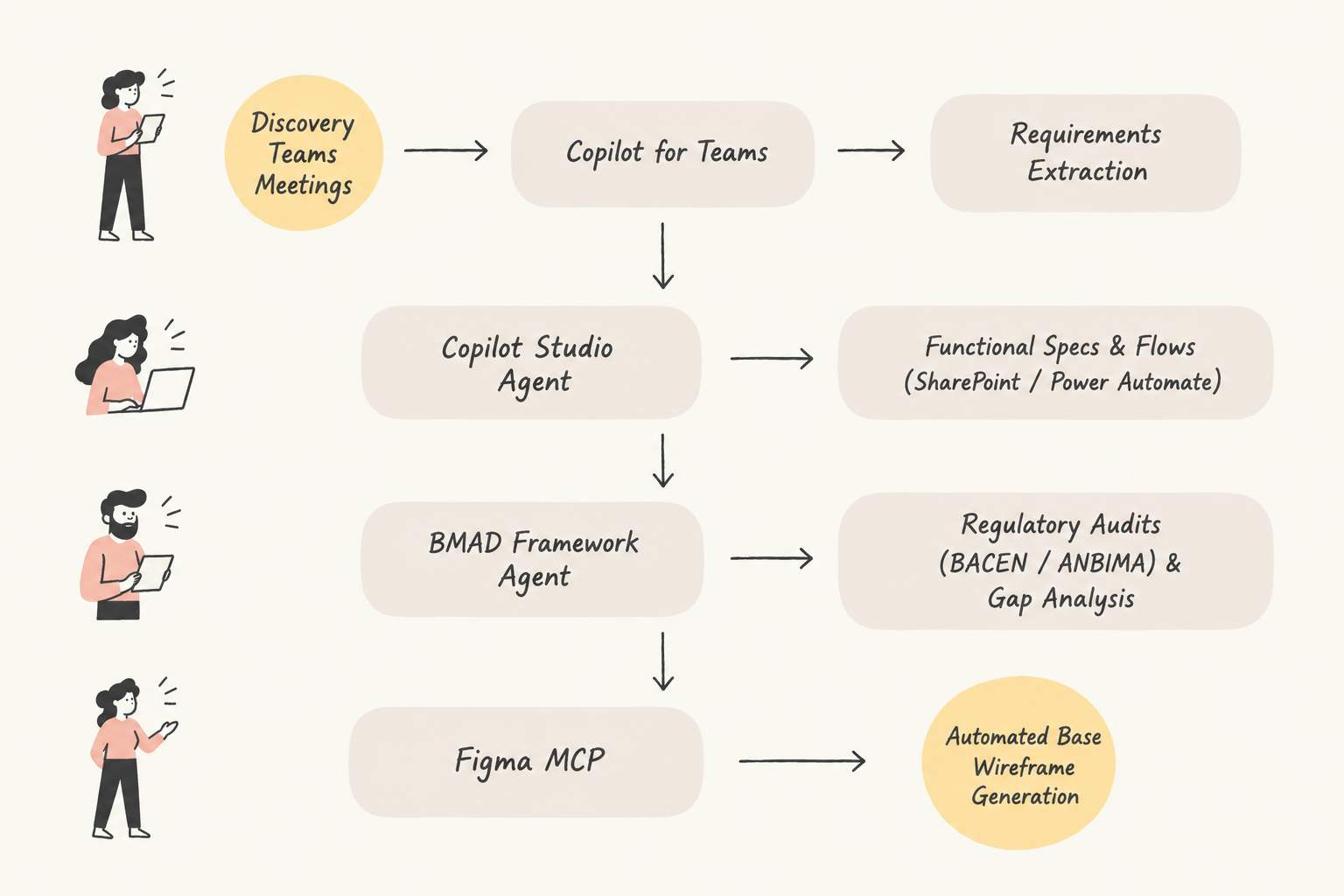
To build predictability and accelerate the discovery phase before new urgencies took over, I designed and integrated an AI-driven Design Ops pipeline:
5. How the pipeline works:
Requirements Extraction (Copilot for Teams): Automatically transcribes alignment sessions to extract business rules, operational constraints, and user pain points.
Workflow Modeling (Copilot Studio + Power Automate): A custom agent processes meeting transcriptions into SharePoint, automatically drafting project summaries and user flow logic.
Regulatory Audit & Gap Mapping (BMAD Method): An agent built on the BMAD Method audits flows against financial regulations (BACEN, ANBIMA). It highlights compliance risks and flags unaddressed corner cases before human design work begins.
Automated Wireframing (Figma MCP): Structured Markdown specs are sent directly to Figma via Model Context Protocol (MCP), generating an initial visual layout structured by release stages (MVP vs. future enhancements).
6. Applying the pipeline: order ticket tracking (boletas)
Agile Discovery: Conducted interviews with Product Managers, Engineering, and Customer Support agents. Fed all transcriptions and internal process docs into the AI pipeline.
Rapid Generation: The AI pipeline delivered functional specifications and an initial Figma prototype in hours.
Targeted Design Refinement: With the base layout generated automatically, I focused human design efforts on edge cases, CSV upload error handling, and visual polish.
Strategic Operational Validation: Validated the solution directly with the Customer Support team, ensuring alignment with mandatory portal modernization guidelines.
The Delivered Solution: Built a real-time visual tracking dashboard on the client portal. As Back Office progresses with manual validation, a background automation updates the status on screen, eliminating information asymmetry.
I’m sorry, but due to NDA, i can’t disclosure any UI to you :(
Outcomes & Key Results
3x Faster Cycle Time: Reduced the discovery-to-prototype phase from 3 weeks to 1 week.
Operational Relief: Expected a significantly reduced support desk call volumes and email inquiries during high-volume market windows.
New Design Benchmark: Successfully used this pilot to establish an AI-powered Design Ops standard across Investment Services.
My role & impact
End-to-End Execution: Architected the AI agents and workflow automation (Copilot Studio, Power Automate, SharePoint, Figma MCP) while leading core Product Design (Discovery, Prototyping, and Validation).
Design Ops & RegTech: Embedded regulatory compliance checks (ANBIMA/BACEN) directly into early-stage design loops via the BMAD Method.
Stakeholder Alignment: Connected Product Managers, Engineering, Operations, and Executive Leadership around a predictable, fast-paced delivery process.